Showing posts with label American Civil War. Show all posts

Friday, June 24, 2016

The Free State of Jones Movie

I just viewed the movie, The Free State of Jones, on its debut in Newton, Kansas. I wanted to see this film because this group of anti-Confederates in Mississippi is in my book Hiram's Hope. After leaving the filthy prison at Andersonville for Vicksburg in the spring of 1865, the prisoners are forced to walk after being dumped off rickety rail cars in the war-torn, no-man's land around Jackson, Mississippi . They then come across some of these Free State men and warily engage in conversation. The prisoners learn about the hated conscription act and twenty slave rule, that along with Confederate army raids on their farms, drove these men to rebel against the Confederate government and to set up their own "country", The Free State of Jones. I believe this meeting was possible although I did not find any mention of it in the literature or writings of Andersonville prisoners.

The movie opens with graphic views of the fighting in the Civil War.  Although these made my wife cringe, I think seeing exploding heads, gaping abdominal wounds, hogs chewing on corpses, and screaming soldiers undergoing amputations is necessary to a proper view of the Civil War.  So much of the savagery is skipped over in discussions of war that we forget how awful it was for the soldiers on both sides.  Newton Knight, the historical figure who founded the Free State of Jones, flees the carnage (after carrying home the corpse of a young relative) and, now a deserter, makes his way to the swamps.  Here he meets up with escaped slaves and other deserters who he eventually organizes into a small army.  They join local families in defying Confederates trying to capture deserters and enforce conscription while raiding local farms to supply Southern armies fighting further north.  Knight's army of deserters and slaves grows as the war turns against the Confederacy.  So does the viciousness of the fighting and retributions. Young boys and slaves are hung after surrendering and  skirmishes and battles with Confederates are shown in gruesome detail.

Finally the war ends and reconstruction begins but the fires of joys are soon extinguished in the rise of the Ku Klux Klan, black codes, and lynchings. Even the descendants of Knight are shown fighting laws against mixed marriage in the Mississippi courts decades later. While there are many fictional scenes in the movie, I believe it was well done and reflects not only history but the emotional human drama of the times. The Free State of Jones has an R rating but the violence underscores the realities of the times, something that we need to know and feel if we are to learn from history.


 Prisoners leaving for home at the end of the war.

  Book cover showing prisoners on the exploding Sultana after leaving Vicksburg.

Thursday, May 14, 2015

The Whirlwind of War by Stephen B. Oates

Front Cover 

I just finished reading one of the best books I have ever read on the Civil War. The Whirlwind of War by Stephen B. Oats is a very readable, intensively researched and documented, masterpiece. Oates employs a unique approach to the book's format--he writes in the first person from the views of leading characters in the Civil War such as Abraham Lincoln, U. S. Grant, Robert E. Lee, Jefferson Davis, even John Wilkes Boothe. This he carries off masterfully with every event  portrayed meticulously documented and backed up by letters, diaries, biographies, and other well respected primary and secondary books and manuscripts. I am considering writing Hiram's Heart, the third book in my Civil War trilogy, using this first person viewpoint style with Hiram Terman, my ancestor as the main character supported by others such as Isaiah, Bushey, Seth, and other characters from Hiram's Honor and Hiram's Hope.  I certainly have a good example to try to emulate in this awesome book.  Michael Shara's novel The Killer Angels was also written in this way as was David Grub's novel The Voices of Glory and Cynthia Bass's novel Sherman's March.  I have read Shara's novel but need to check out the books by Grub and by Bass.


Wednesday, March 4, 2015

Hiram's Heart and the faith of Abraham Lincoln


The stress of the presidency and the Civil War shows on Abraham Lincoln (1858 and 1865). No president quoted the Bible more yet his religious views are complex and controversial.  My ancestor Private Terman, after having survived the Civil War and 17 months a prisoner of war (including Andersonville) also exhibited signs of emotional distress and struggles of faith in his pension file documents. I am working on a third book in my account of Hiram's Civil War experiences tentatively entitled Hiram's Heart: To The Shining Shore.

This book would complete a trilogy--- Hiram's Honor, Hiram's Hope, and Hiram's Heart. Since Abraham Lincoln was a model of faith for many Civil War veterans, I am exploring how Lincoln's and my ancestor's struggles to understand God's purposes in their lives and the Civil War might be part of a post-Civil War novel.

To read about Abraham Lincoln's faith, see Mark Noll's article at:

http://www.christianitytoday.com/ch/1992/issue33/3311.html

Monday, December 1, 2014

Hiram's Honor and Hiram's Hope available in Marion, Ks


Hiram's Honor and Hiram's Hope are available in Marion, Kansas at Gallery 101, 106 E. Main St. Marion, KS.

Tuesday, November 11, 2014

The Civil War: A Conversation With My Ancestor


I impersonated my great uncle Private Hiram Terman in a presentation at Tabor College. Many in the audience commented that it made the Civil War more real to hear about it in the first person.  Indeed, would it not have been a memorable experience to be able to talk to a Civil War veteran about his trials and tribulations.  See recent newspaper article at:
Hiram’s Hurrah Hillsboro Free Press http://tinyurl.com/nryf5sn
To view the video see http://tinyurl.com/o4fansz


Tuesday, August 19, 2014

HIRAM'S HOPE IS LAUNCHED


Sign near Marion, Arkansas and actual photo of Sultana--major parts of the story line of Hiram's Hope.

Hiram's Hope: The Return of Isaiah by Max R. Terman. 2014 TESA Books, Hillsboro, Ks, $14.99 print, $2.99 eBook, 260 pages print.  Printed and distributed by Lightning Source Incorporated, Ingram Book Company.

ISBN 978-1-4951-0591-3 

Following in the footsteps of Hiram’s Honor, one of Online College’s Best Books for Studying the Civil War, Hiram’s Hope tells how Isaiah, left for dead at Andersonville, survives only to board the ill-fated, over-loaded steamer Sultana. Max Terman weaves a story around this tragedy with the Lincoln Funeral Train, a woman left at Andersonville, and a veteran’s struggle to recover his life as threads in an intricate tale about the last days of the American Civil War.

Hiram’s Hope has been published, and is available at Ingram Book, Amazon, and other booksellers. Signed copies are available from the author at maxt@tabor.edu. Professional reviews of the book can be seen at: http://tinyurl.com/mc9oc7k . Sample material and a chapter can be seen at: http://tinyurl.com/oe3ytcn  Author information:  http://www.amazon.com/-/e/B001HPJGH0

Click here to buy online at Amazon.


Thursday, March 27, 2014

HIRAM'S HOPE: THE RETURN OF ISAIAH


The rough draft of Hiram's Hope is out for review and comments.

I hope to have it published by September 2014.


Friday, November 29, 2013

12 Years A Slave Movie and Book


Illustration from 12 Years a Slave by Solomon Northup (published 1853)

I went to see the movie "12 Years A Slave" in hopes of learning more about slavery from the perspective of a slave.  I may incorporate a former slave as a charaacter in the sequel to Hiram's Honor.  I was so taken by the story that I looked up the original book published in 1853. I read the first person account with images from the movie in my mind. For the most part the movie follows the book. The written account has much more detail and is thus more valuable to understanding the author and thus building a character for my story.  I was amazed at how Solomon Northup, an educated free black man kidnapped into slavery, was able to experience the trials of being a slave and yet retain hope for returning to freedom.  The injustice of the story overwhelms you but in the end you rejoice with Northup as he rejoins his family after 12 years in the most brutal of circumstances. 


Tuesday, October 29, 2013

Reunion and reconciliation

In my search for ideas on how Private Hiraqm Terman might have dealt with his Civil War battle and prisoner of war experiences, I read Caroline Janney's new book REMEMBERING THE CIVIL WAR.  I found the book to be well researched and written in a way that held my attention.  The theme of the book centers on the difference between reunion and reconciliation and explores the perspectives of Union and Confederaate men and women. As I write the sequel to Hiram's Honor, I hope that the things I learned in this fine book will show up in the story.  

Thursday, October 24, 2013

How Did Hiram Cope?

 
I came across a book entitled MAN'S SEARCH FOR MEANING by Holocaust survivor and psychologist Victor Frankl. In this fascinating book (it has sold over 10 million copies) Frankl describes how he was able to survive the test of the German concentration camps by looking on his suffering as an opportunity to find his identity and give meaning to his life. I read his emotional but reasonable descriptions hoping to find some ideas on how to write about how my ancestor might have coped with being an Andersonville survivor.  We will see what comes out when I write about Private Terman after Andersonville.

Thursday, August 22, 2013

HIRAM'S HOPE--the sequel to Hiram's Honor


The Sultana, an overcrowded boat carrying already wretched and suffering Union prisoners of war from Andersonville and other prisons, unbelievably explodes and either burns them alive or casts them into the cold Mississippi River to die of exposure to the cold waters.  One 82nd Ohio soldier is recorded as being on the Sultana and it is this prisoner that I have identified as Isaiah, Hiram's friend left at Andersonville as Hiram and his ambulatory friends leave for Savannah and later Millen where they were eventually exchanged.  According to my story (which is fiction based on actual accounts of Sultana survivors) Isaiah is blown from the boat into the dark waters of the Mississippi.  Following is the opening "hook" to Hiram's Hope:


             A flash of light, his body spinning in the darkness, a glimpse of the rainy night sky followed by the stinging slap of the water’s surface and the numbing grip of coldness. 
            Oh, Lord, I am in the water, sinking! I can’t breathe—must get to the surface!  Isaiah stretched his neck, his stunned arms and legs slow to move in the icy cold waters of the Mississippi River.  His lungs screamed for air, demanding his legs to kick.  A thumping, crackling sound permeated the swirling cold darkness as Isaiah moved to the surface.  He coughed as if he were expelling his insides; water ejected out from his nose and ears.  He gasped the cold night air as if it were life itself. He sank again, rising, spitting, and wiping the muddy water from his eyes.
            Off in the distance the Sultana, the over-crowded paddle wheeled steamer loaded with Union prisoners from Andersonville and Cahaba and other Southern Civil War prisons, blazed like a fireball in the darkness.  The waves of the cold Mississippi River, swollen by torrential rains and a massive snowmelt upstream, stretched endlessly into the distance, its brushy, tree-lined shorelines covered by the highest water levels in a decade. 
            Consciousness flowed fully back into Isaiah’s mind.  He looked around and realized that he had been blown off the boat by an explosion.
The officer’s coffin on which he had been forced to sleep on the crowded deck was bobbing off to his right, its hinged lid opened by the impact with the water.  The corpse’s head and arms draped over the side and the dead man’s embalmed face stared at him as if asking-- “Did we make it alright?” 
            As Isaiah watched, the coffin sank below the surface, dragging the officer, recently killed in a guerilla attack outside Vicksburg, to his final, if unplanned, watery grave.  Air bubbles escaping from the coffin burst to the surface. They were his final benediction.
            Isaiah wiped his throbbing eyes, trying to push the blurriness aside to focus on the disaster about two hundred feet away.  The fire grew in size, its blazing light revealed people jumping off the sides, others screamed as the fire demanded they jump or burn.  In the water around the dying boat, heads bobbed like hundreds of apples in a huge tub.  Above the hissing and crackling of the flames, Isaiah could hear screams—cries from men, women, and yes, children.  Oh God, what other glimpses of hell are you going to give me?  First the war, then prison, and now this? No more, Lord, no more….
            Isaiah closed his eyes and began to sink. Calmness came over him as he said a final prayer. Images of home came into view. His angelic mother surrounded by a halo of light, went to the door, and opened it. Hiram Terman stood there, his skeletal thin frame holding the Bible Isaiah gave him before Hiram and his friends left the dying Isaiah at Andersonville.  As Hiram handed the Bible to his mother, she turned, looked to her right. There stood Janie. Immediately the warm light departed and was replaced by the cold water of the Mississippi. His arm thrust to the surface.  His hand felt the rough bark of a floating log.

Wednesday, May 22, 2013

Coldwater, Michign Daily Reporter article on Hiram's Honor


Author Max Terman with newly published book.
Many of my wife's relatives live in or near Coldwater, Michigan so it was a pleasure to have an article on Hiram's Honor appear in the newspaper there.  Coldwater was an important supplier of Union soldiers for Michigan during the American Civil War and interest in the war runs deep there.  Even though my ancestor was from Ohio, telling his story helps showcase the experiences of all Civil War soldiers, including those from Michigan. Many thanks to the Daily Reporter. To read the article see http://www.thedailyreporter.com/article/20130520/NEWS/130529991.

Monday, May 6, 2013

April 1865 by Jay Winik


As part of my research for the sequel to Hiram's Honor, I read Jay Winicks April 1865. This book focuses on the month, that among other happenings, saw the fall of Richmond, the surrender of Robert E. Lee to U. S. Grant at Appomattox, the assassination of President Abraham Lincoln, and the surrender of Joseph Johnson's army to General William Sherman. Since I wanted to get a feel for the deeper and personal meanings of the war at its end, this book proved very helpful. Winik put the war and the people into context using an engaging but factually rich style. The main point was that this conflict, unlike many others, ended without a prolonged and agonizing guerilla war, primarily due to the conciliatory policies of Lincoln, Grant, and Sherman and the insights and courage of Lee and other Confederate generals.  My only disappointment was that the explosion of the Sultana (that happened on April 27, 1865) was not mentioned. Ironically, the tragedy of the Sultana was also given limited coverage to the war weary public at the time as well.


Friday, May 3, 2013

Pages Books and Coffee Newton Ks book event


 I am pleased to report that Pages Books and Coffee in Newton, Kansas is now selling Hiram's Honor. On May 2, 2013 at a book event there, I discussed the Civil War, Abraham Lincoln, and other topics associated with Hiram's Honor. Many questions dealt with how fragile the United States was as a nation before and after the Civil War and how the wise and gracious actions of Abraham Lincoln, U. S. Grant, and Robert E. Lee saved the Union.

Also, it was pointed out how my ancestor Private Hiram Terman of the 82nd Ohio had a close, personal and inside look at the major events of the Civil War--that he did and I hope that I conveyed this in telling his story.


Wednesday, April 3, 2013

Kauffman Museum Newton, Kansas now selling Hiram's Honor

Cabin
I am pleased to announce that the Kauffman Museum in Newton, Kansas now has Hiram's Honor for sale in their gift shop. We went to this fine museum to view the exhibit Lincoln: The Constitution and the Civil War.  This was timely since I am researching the personality of Abraham Lincoln for a chapter dealing with the Lincoln Funeral Train in my sequel to Hiram's Honor.  It is about the experiences of Hiram and his friends after their release from Andersonville and in the post-Civil War years and is based on Hiram's Civil War pension files.

Thursday, February 28, 2013

I Met Abraham Lincoln in Florida

While in Florida I met Abraham Lincoln impersonator Chet Damron.  We talked about Lincoln's personality and the effect he had on soldiers.  My ancestor Private Hiram Terman saw President Lincoln in person on April 9, 1863 at a review of the army near Stafford Virginia just before the battle of Chancellorsville.  Many soldiers expressed how the review and seeing Abe Lincoln gave them new hope and confidence.  I put this in Hiram's Honor.  I felt a little of what my ancestor might have experienced as I talked to "old Abe" in person so to speak. For free chapters to explore in Hiram's Honor, see
http://tinyurl.com/7pg7tfr     Gettysburg
http://tinyurl.com/6n495ql   Andersonville Prison
http://tinyurl.com/6urlc8m   Belle Island Prison

Tuesday, January 22, 2013

Pathway to Hell by Dennis W. Brandt

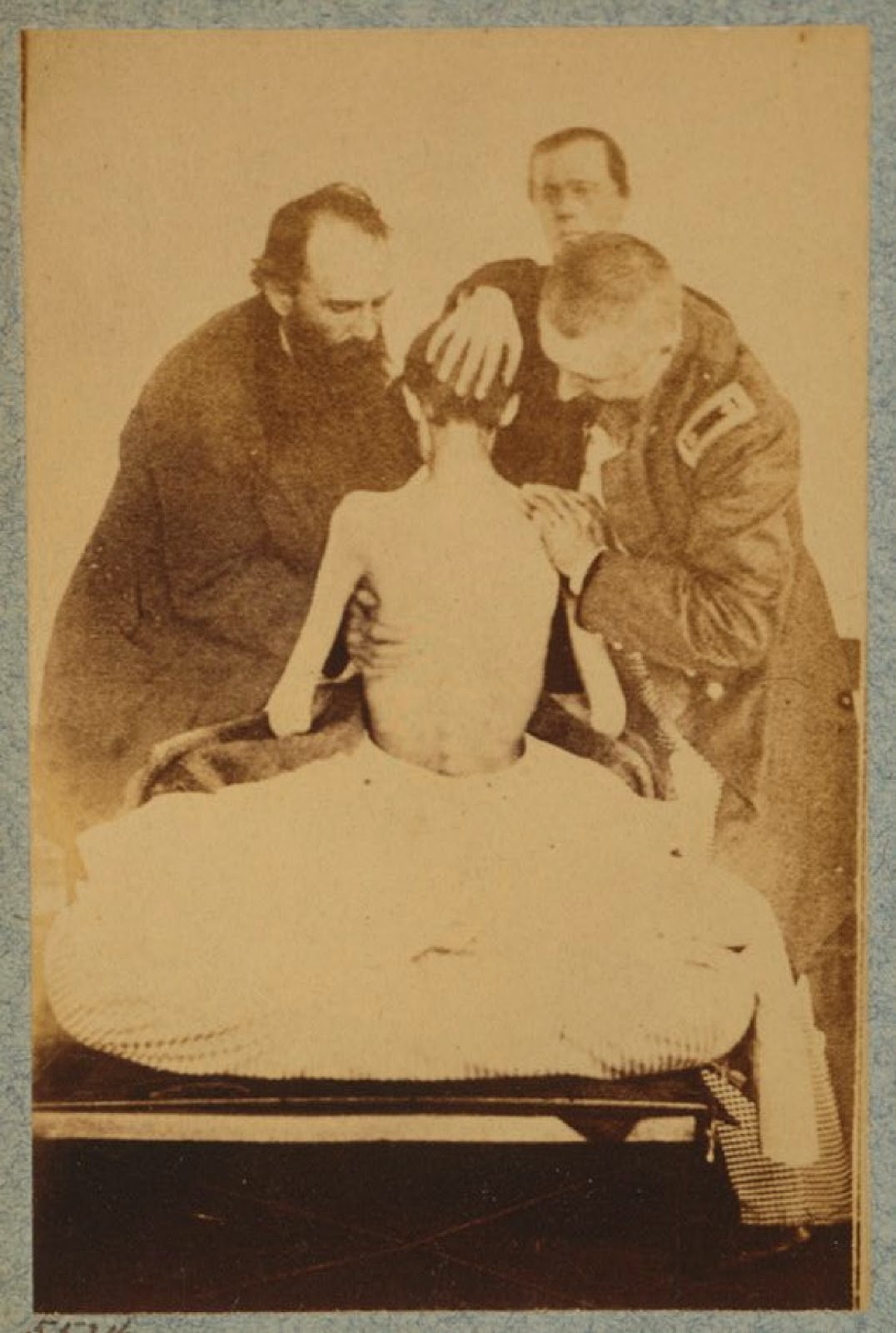
Surgeons examining Andersonville prison survivor--the physical damage was only part of the story
I have just finished reading Pathway to Hell: A Tragedy of the American Civil War by Dennis W. Brandt.  It is the story of one Civil War soldier, Angelo Crapsey, who might have suffered from what we today call PTSD (post traumatic stress disorder), what then was termed nostalgia, soldier's heart, or a variety of other terms, if it was identified at all.  Private Crapsey, who committed suicide after the war, left a series of letters that along with other historical documents and records, were psychologically analyzed by author Brandt, looking for evidence that this soldier exhibited PTSD. I read this book in hopes of getting insights into what my ancestor may have faced as a result of his war and prison ordeals.  Few books have dealt with this topic for Civil War soldiers and I found the information very helpful in understanding what Private Terman and his family might have faced after the Civil War, the basis for my sequel.

Saturday, December 15, 2012

Andersonville Civil War Prison by Robert Scott Davis

Sketch of Andersonville Prison


I have just finished reading Robert Scott Davis Andersonville Civil War Prison published by The History Press.  I was searching for information on the life spans of Andersonville survivors and for what happened during the last days of the prison for my sequel to Hiram's Honor.  I found the book to have an air of authority as the author is a college professor and researcher.  According to a source in this book, less that 1000 Andersonville survivors lived past 1890.  This makes the survival of Private Hiram Terman especially noteworthy.  He was one of the first prisoners in (July 1863) and one of the last out (January 1865) and yet lived until 1926--remarkable!  To read an account of the conditions at Andersonville by Isaiah White, Confederate surgeon, see this primary source. Also above is a monument in Andersonville village for Henry Wirz and a close-up of one of the inscriptions.  Quite a story here--I hope I can capture some more of it in my sequel. To read the present Andersonville chapter in Hiram's Honor, click Andersonville chapter Hiram's Honor