Showing posts with label Civil War Veterans. Show all posts

Tuesday, August 19, 2014

HIRAM'S HOPE IS LAUNCHED


Sign near Marion, Arkansas and actual photo of Sultana--major parts of the story line of Hiram's Hope.

Hiram's Hope: The Return of Isaiah by Max R. Terman. 2014 TESA Books, Hillsboro, Ks, $14.99 print, $2.99 eBook, 260 pages print.  Printed and distributed by Lightning Source Incorporated, Ingram Book Company.

ISBN 978-1-4951-0591-3 

Following in the footsteps of Hiram’s Honor, one of Online College’s Best Books for Studying the Civil War, Hiram’s Hope tells how Isaiah, left for dead at Andersonville, survives only to board the ill-fated, over-loaded steamer Sultana. Max Terman weaves a story around this tragedy with the Lincoln Funeral Train, a woman left at Andersonville, and a veteran’s struggle to recover his life as threads in an intricate tale about the last days of the American Civil War.

Hiram’s Hope has been published, and is available at Ingram Book, Amazon, and other booksellers. Signed copies are available from the author at maxt@tabor.edu. Professional reviews of the book can be seen at: http://tinyurl.com/mc9oc7k . Sample material and a chapter can be seen at: http://tinyurl.com/oe3ytcn  Author information:  http://www.amazon.com/-/e/B001HPJGH0

Click here to buy online at Amazon.


Friday, August 1, 2014

Thursday, March 27, 2014

HIRAM'S HOPE: THE RETURN OF ISAIAH


The rough draft of Hiram's Hope is out for review and comments.

I hope to have it published by September 2014.


Tuesday, October 29, 2013

Reunion and reconciliation

In my search for ideas on how Private Hiraqm Terman might have dealt with his Civil War battle and prisoner of war experiences, I read Caroline Janney's new book REMEMBERING THE CIVIL WAR.  I found the book to be well researched and written in a way that held my attention.  The theme of the book centers on the difference between reunion and reconciliation and explores the perspectives of Union and Confederaate men and women. As I write the sequel to Hiram's Honor, I hope that the things I learned in this fine book will show up in the story.  

Wednesday, May 22, 2013

Coldwater, Michign Daily Reporter article on Hiram's Honor


Author Max Terman with newly published book.
Many of my wife's relatives live in or near Coldwater, Michigan so it was a pleasure to have an article on Hiram's Honor appear in the newspaper there.  Coldwater was an important supplier of Union soldiers for Michigan during the American Civil War and interest in the war runs deep there.  Even though my ancestor was from Ohio, telling his story helps showcase the experiences of all Civil War soldiers, including those from Michigan. Many thanks to the Daily Reporter. To read the article see http://www.thedailyreporter.com/article/20130520/NEWS/130529991.

Wednesday, April 3, 2013

Kauffman Museum Newton, Kansas now selling Hiram's Honor

Cabin
I am pleased to announce that the Kauffman Museum in Newton, Kansas now has Hiram's Honor for sale in their gift shop. We went to this fine museum to view the exhibit Lincoln: The Constitution and the Civil War.  This was timely since I am researching the personality of Abraham Lincoln for a chapter dealing with the Lincoln Funeral Train in my sequel to Hiram's Honor.  It is about the experiences of Hiram and his friends after their release from Andersonville and in the post-Civil War years and is based on Hiram's Civil War pension files.

Tuesday, January 22, 2013

Pathway to Hell by Dennis W. Brandt

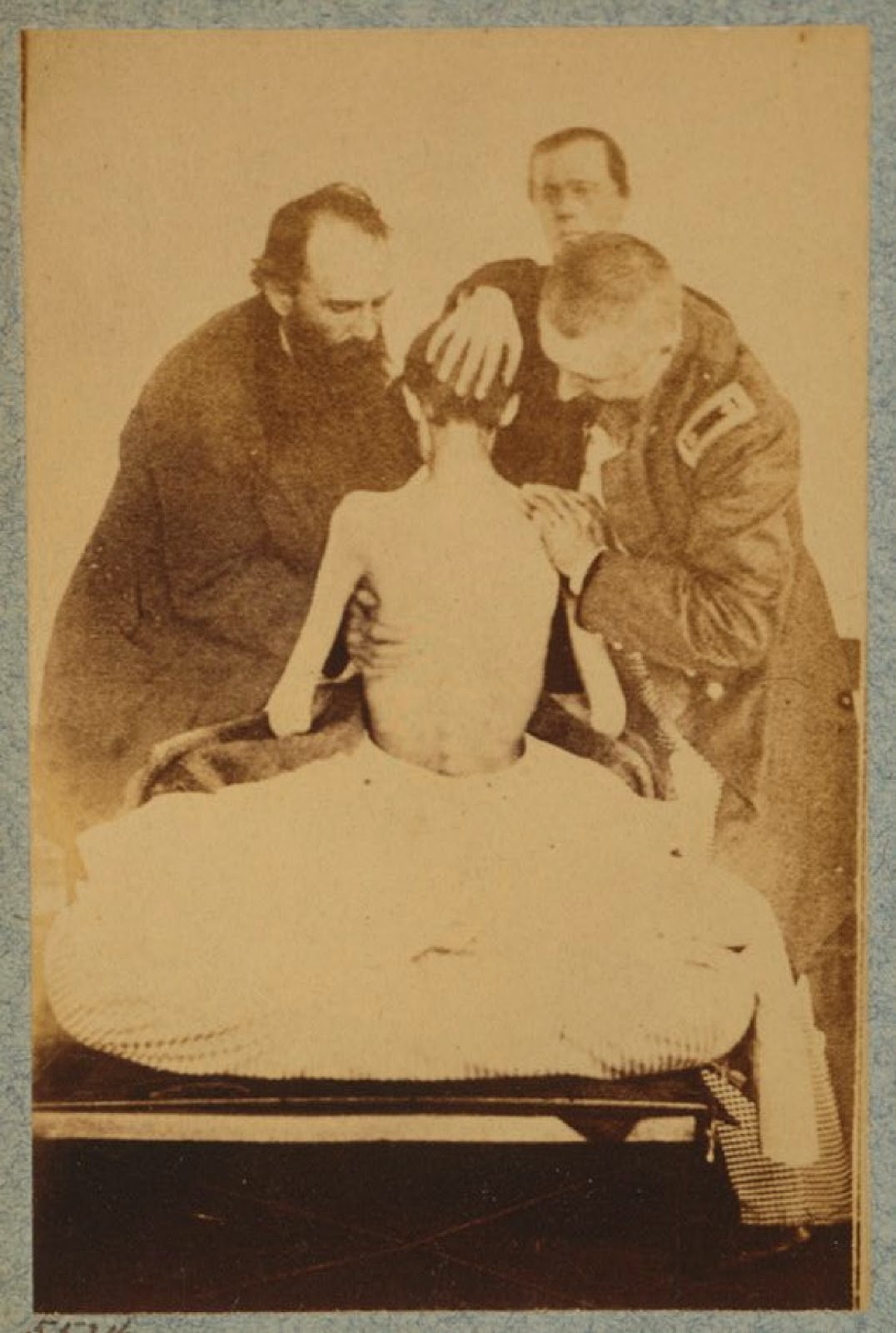
Surgeons examining Andersonville prison survivor--the physical damage was only part of the story
I have just finished reading Pathway to Hell: A Tragedy of the American Civil War by Dennis W. Brandt.  It is the story of one Civil War soldier, Angelo Crapsey, who might have suffered from what we today call PTSD (post traumatic stress disorder), what then was termed nostalgia, soldier's heart, or a variety of other terms, if it was identified at all.  Private Crapsey, who committed suicide after the war, left a series of letters that along with other historical documents and records, were psychologically analyzed by author Brandt, looking for evidence that this soldier exhibited PTSD. I read this book in hopes of getting insights into what my ancestor may have faced as a result of his war and prison ordeals.  Few books have dealt with this topic for Civil War soldiers and I found the information very helpful in understanding what Private Terman and his family might have faced after the Civil War, the basis for my sequel.

Tuesday, November 6, 2012

Civil War Monument Quincy Michigan


Many towns have Civil War monuments honoring the regiments that came from that town.  This monument is in the cemetery at Quincy, Michigan.  I came across it while visiting relatives, my brother-in-law showed it to  me. Viewing this statue and the writings on its side caused me to relive the poignant events I described in Hiram's Honor.  Relive the battle of Gettysburg here.

Saturday, July 21, 2012

Civil War Prisoners of War

The prisoners of war returning from Andersonville and other prisons not only suffered the numbing terror of horrendous battles but had to endure the grinding misery of starvation in the prison camps.  The sequel to Hiram's Honor, tentatively titled Hiram's Hope, examines how my ancestor Private Hiram Terman, coped after his return.  Based on his pension files, it is a novel about how again, as in battle, the help of his comrades lifts him from lonely isolation to a life of hope.
“As for myself, I never felt so utterly depressed, cursed, and God-forsaken in all my life before. All my former experiences in battles, on marches, and at my capture were not a drop in the bucket as compared with this.” —Walter E. Smith, Pvt., Co. K, 14th Illinois Infantry commenting on his time at Andersonville


Monday, January 9, 2012

Civil War Veterans video

Click on the link below to see video of Civil War Veterans at 1913 and 1938 Reunions at Gettysburg.  I wonder if my ancestor and subject of Hiram's Honor, Private Hiram Terman, attended these gatherings.

Civil War veterans video

Friday, November 4, 2011

Civil War Pension Files from the National Archives


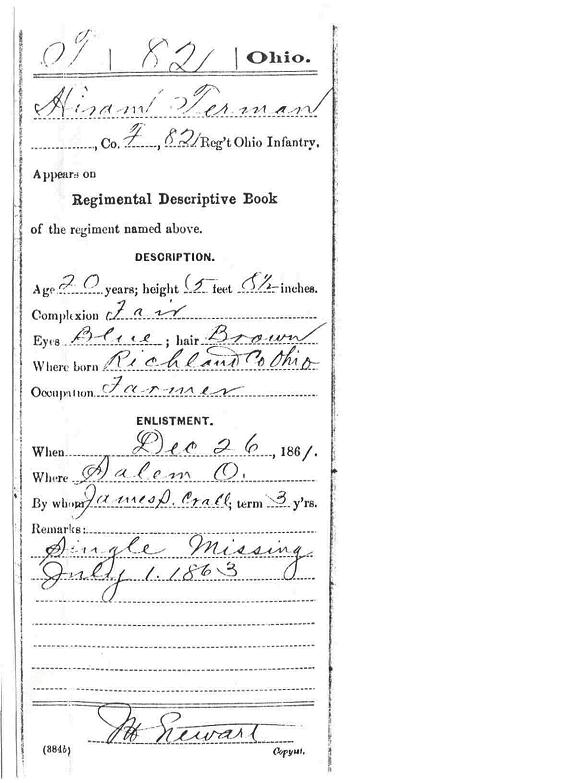
I ordered my Civil War ancestor's pension files from the National Archives and received 125 pages of information like the above documents.  Private Terman was a walking skeleton when he came back from 17 months of prison life at Belle Island, Andersonville, Savannah, and Millen.  Incredibly, he waited until 1897 to apply for a pension that he received until his death in 1926.  His Civil War service gave him heart problems, rheumatism, stomach, and bowel problems his entire life and he also suffered from what we now call Post Traumatic Stress Syndrome.  I am researching these files in hopes of writing a sequel to Hiram's Honor about his and his comrades post Civil War lives.

Wednesday, October 12, 2011

Civil War Pension file Youtube

Civil War pension files contain very useful information.  For an example of how a file looks see http://www.youtube.com/watch?v=XFRlBEjKG7Y

Wednesday, September 28, 2011

The Civil War Veteran by Larry Logue and Michael Barton

I am reading The Civil War Veteran: A Historical Reader edited by Larry M. Logue and Michael Barton which gives an insightful overview of what it was like for Civil War veterans after the shooting stopped and regular living began.  Difficult enough for regular soldiers, what must it have been like for prisoners of war from Andersonville?


Monday, August 8, 2011

Sing Not War

I am now reading Sing Not War by James Marten which describes the post-war experiences of Civil War veterans.  It was interesting to discover the controversies surrounding pensions and soldier's homes in the period 1865-1910.  Many Civil War veterans (both Union and Confederate) experienced difficult times socially and economically after the war, especially the disabled.   Others  adapted to the "men--help yourself up" attitudes and industrialization of the Gilded Age.  Most Civil War memoirs and other writings did not come out or become popular until the 1880's.  It was as if thoughts on the Civil War were not popular early on and then became interesting after a decade or two.