Thursday, January 24, 2013

Tuesday, January 22, 2013

Pathway to Hell by Dennis W. Brandt
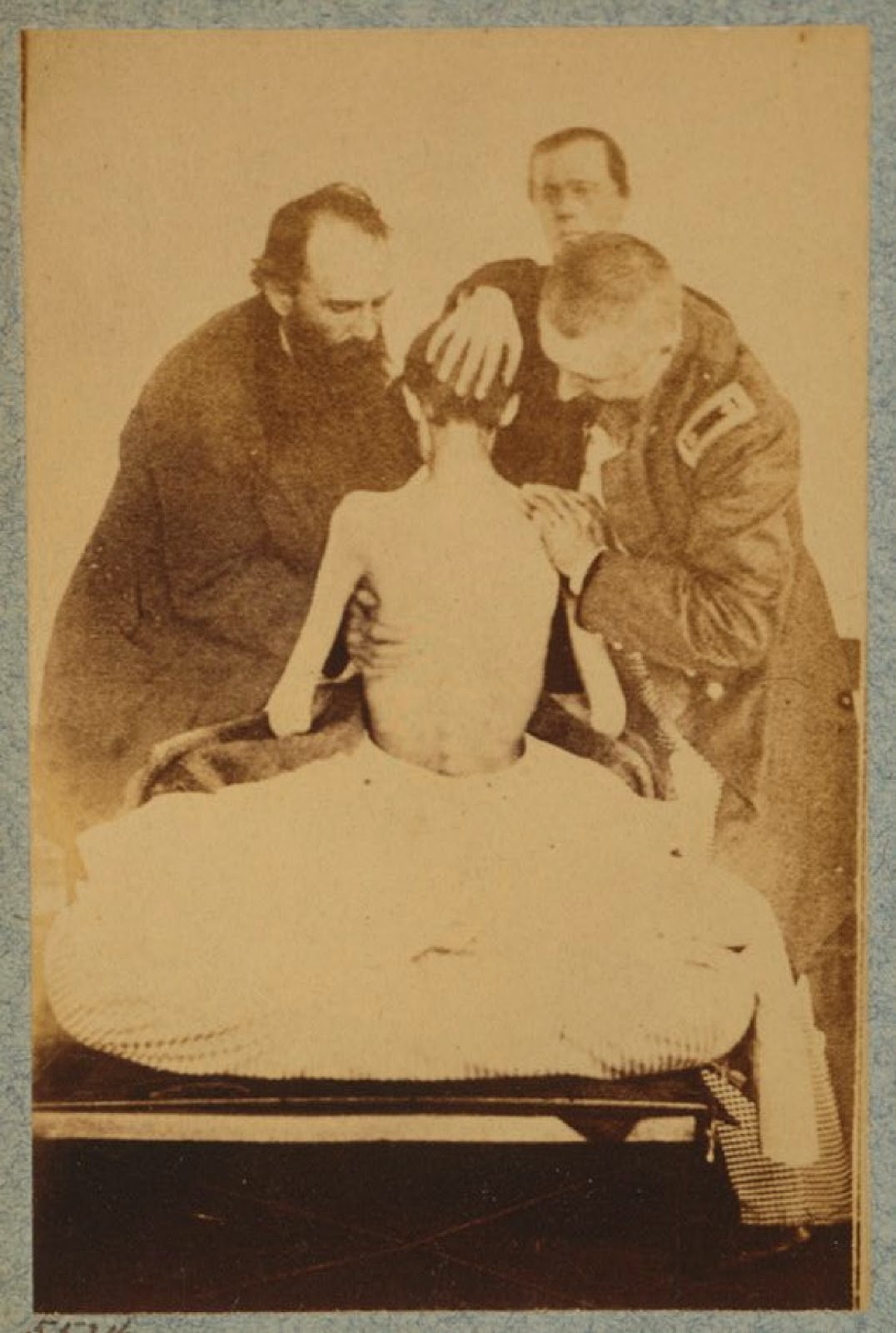
Surgeons examining Andersonville prison survivor--the physical damage was only part of the story
I have just finished reading Pathway to Hell: A Tragedy of the American Civil War by Dennis W. Brandt.  It is the story of one Civil War soldier, Angelo Crapsey, who might have suffered from what we today call PTSD (post traumatic stress disorder), what then was termed nostalgia, soldier's heart, or a variety of other terms, if it was identified at all.  Private Crapsey, who committed suicide after the war, left a series of letters that along with other historical documents and records, were psychologically analyzed by author Brandt, looking for evidence that this soldier exhibited PTSD. I read this book in hopes of getting insights into what my ancestor may have faced as a result of his war and prison ordeals.  Few books have dealt with this topic for Civil War soldiers and I found the information very helpful in understanding what Private Terman and his family might have faced after the Civil War, the basis for my sequel.

Saturday, December 15, 2012

Andersonville Civil War Prison by Robert Scott Davis

Sketch of Andersonville Prison


I have just finished reading Robert Scott Davis Andersonville Civil War Prison published by The History Press.  I was searching for information on the life spans of Andersonville survivors and for what happened during the last days of the prison for my sequel to Hiram's Honor.  I found the book to have an air of authority as the author is a college professor and researcher.  According to a source in this book, less that 1000 Andersonville survivors lived past 1890.  This makes the survival of Private Hiram Terman especially noteworthy.  He was one of the first prisoners in (July 1863) and one of the last out (January 1865) and yet lived until 1926--remarkable!  To read an account of the conditions at Andersonville by Isaiah White, Confederate surgeon, see this primary source. Also above is a monument in Andersonville village for Henry Wirz and a close-up of one of the inscriptions.  Quite a story here--I hope I can capture some more of it in my sequel. To read the present Andersonville chapter in Hiram's Honor, click Andersonville chapter Hiram's Honor

Thursday, November 29, 2012

The Untried Life: the 29th OVI in the Civil War by James T. Fritsh

Battle of Cedar Mountain where both the 29th and 82nd Ohio were engaged.
I have just finished reading The Untried Life: the 29th Ohio Volunteer Infantry in the Civil War by James T. Fritch.  I hoped to find some stories from the 29th OVI that would shed more light on the what happened to soldiers in Private Terman's regiment, the 82nd Ohio.  Both regiments came from northern Ohio and fought in some of the same battles, such as Cedar Mountain, Chancellorsville, and Gettysburg.  What I found was an exceptionally well-written, researched, and documented book with many details coming out of the Giddings Regiment (also called the Abolitionist Regiment named after Congressman J. R Giddings of Ohio).  One that comes to mind was of a sane inmate of an "Insane Asylum" in the south that the boys of the 29th uncovered toward the end of the war.  This sane and intelligent man had been put there by his father to prevent him from enlisting with the Union.  Every page has many such accounts along with the names of the soldiers who lived the stories.  It is a long book of 501 pages and each page is printed in small type but I found myself thoroughly enjoying the journey.

Monday, November 26, 2012

The movie "Lincoln"

National Archives copy of the Thirteenth Amendment

After watching the movie "Lincoln" and seeing the personal attributes of President Abraham Lincoln and what it took to pass the 13th Amendment abolishing slavery, I can understand the deep affection that Union soldiers such as my ancestor Private Hiram Terman of the 82nd Ohio had for the President.  The scene that sent chills up my spine and tears to my eyes was of the celebration in Congress after passing the amendment as they sang "Rally 'Round the Flag".  I wonder if the ancestral genes of my Civil War ancestor in my being were stimulated.  Although some say this is not an academic historical portrayal (for one historian's opinion click here) I heartily recommend the movie.

Back then they called Lincoln a dictator, a baboon, the original gorilla, and things much worse.  He was hated and loved at the same time.  The genius of democracy is that things still got done like passing the 13th Amendment in a time as racially divided and politically aggressive as the Civil War era. 

My guideline for political discourse today with someone I disagree:  " I respect a person's right to have an opinion even if it conflicts with my passionately held basic beliefs.   However, because I am civil and respectful in my discourse does not mean that I approve of his position, just that I recognize his personhood and that he, like I, is human, a child of God, with all the limits, rights, and responsibilities that that entails."


Tuesday, November 6, 2012

Civil War Monument Quincy Michigan


Many towns have Civil War monuments honoring the regiments that came from that town.  This monument is in the cemetery at Quincy, Michigan.  I came across it while visiting relatives, my brother-in-law showed it to  me. Viewing this statue and the writings on its side caused me to relive the poignant events I described in Hiram's Honor.  Relive the battle of Gettysburg here.

Friday, October 19, 2012

Return to Chancellorsville

We have just returned from a trip to the Chancellorsville battlefield where we again retraced the steps of my ancestor as he survived the flank attack of Stonewall Jackson.  Above is a view of the Hawkins farm area where the 82nd Ohio was stationed and awaited the onslaught that pushed the regiment back to the Chancellor house area.